Tuesday, 26 May 2015

The role of Creativity, Innovation & Critical Thinking within Technology learning

Talofa lava. Malo le soifua. O nai ou lagona nei mo lenei vaiaso 
(A warm Samoan Language week greeting )

The national workshop for technology 2015 delivery, has been a success up and down New Zealand, with 400+ Teachers and Middle Leaders in attendance. 


This particular blog post is my reflection (Thinking about Thinking)
Originally named The Poet (French: Le Poète), the Thinker was initially a figure in a large commission, begun in 1880, for a doorway surround called The Gates of Hell. Rodin based this on The Divine Comedy of Dante, and most of the many figures in the work represented the main characters in the epic poem.


and a summary of session 3 from the workshop, on the meaning of Creativity, Innovation & Critical Thinking.

From P32 of the NZC… 


"Technology is intervention by design: the use of practical and intellectual resources to develop products and systems (technological outcomes) that expand human possibilities by addressing needs and realising opportunities. Adaptation and innovation are at the heart of technological practice. Quality outcomes result from thinking and practices that are informed, critical, and creative."

Creativity
 So in showing the next slide we wanted some robust discussion around Ken Robinson's remark and to really unpack his theory behind the statement. 
What are you thoughts?
  
The video below of Sir Ken's speech is thought provoking and well worth a watch! 


Creative = the ability to generate ideas that are both new, fresh, novel and appropriate (new, useful, feasible e.g. attribute listing, brainstorming, visioning) It generates possibilities......

What is your definition of creativity? How do you teach this skill to your students?
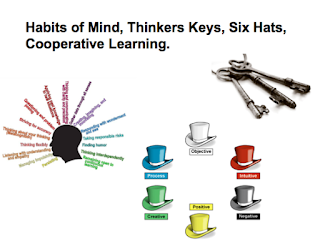

Pedagogical models used in schools to extend creativity and thinking skills.... Are you using any of the above?


 Innovation
http://sciencelearn.org.nz/Innovation 

 The science learning hub is promoting innovative thinking as critical to science education, view the description and decide for yourself if it actually relates to technological practice as well.
 

Innovative thinking = practical application of creative processes to improve or refine existing solutions ( taking existing solutions and redefining and improving to solve specific issues)
Definitions adapted from John Dewey; Richard Paul and Lind Elder; Mihaly Csikszentmihalyi, and M.A. Rosenman and J. S. Gero.)

  
"Innovation is about invention. It is about being able to come up with something that nobody has come up with before. Being an innovative thinker means you have a mind that does not quite work like the logical, down-to-earth mind that the majority of people have" 


Critical Thinking

 
Critical / Analytical = the process in order used to gain a better understanding of something as a whole or in parts , to analyse or dissect and understand the relationship between the parts ( analysis of products, environments, systems) Making decisions, judgements and choices ( Beyer , 1995


Last but by no means least here are some stratagies you could try in class to stimulate Creativity, Innovation and Critical Thinking.......


Thank you to my Colleagues Malcolm Howard, Cheryl Pym and Neville Myers who all had input into the design of the National Workshops for 2015

Tuesday, 12 May 2015

Bits & Pieces of Relevance


I got asked a question by a DVC teacher in a school recently and I mentally noted to respond via the blog as I felt the response would be relevant to many.

The question:  


"I am redesigning my Level 2 DVC course and I wanted to include the generic technology standard AS91363 but I am not sure if it will count towards the 14 credits in one  subject / domain".

My answer: 
http://www.nzqa.govt.nz/qualifications-standards/awards/university-entrance/approved-subjects-for-university-entrance/

Technology Domain is seperated into three subject areas: Technology, Digital technologies & Design and Visual comunications. Each of these subjects hold their own Achievement Standards but also each has access to the generic Technology standards.
Considerations:
If you are offering generic standards within each of the three areas, students cannot be entered for the same standard more than once. This is not in the students best interest. So if they have the same standard in more than one course, only the best result will count. My advice would be to try to limit the cross over credits by planning courses together within the wider technology faculty.

Next Topic
 Internal Moderation requirements

This week saw the first of many 'South Auckland Hard Materials technology cluster groups' hosted at the awesome De La Salle boys school. Within the session we shared a document in which all of the schools present were asked to indicate which standards they offered in the senior school on a spreadsheet to be shared as a tool for organising out of school internal moderation groups.

The need for this group has come about after changes to the NZQA internal moderation requirements. I felt it would be wise to share what we discussed and the relevance to Technology departments. 


The verification process is to ensure that the teacher judgements are consistent with the standard, before they report the results to NZQA. Below are the key changes :


·       It should be undertaken by a subject specialist with standard specific knowledge. The marker should seek verification of samples of work around grade boundaries, as well as for any grades that need review, to satisfy themselves that their decisions are consistent with the standard.
·       Work for verification should be purposefully selected, rather than being selected randomly.
·       Random selection for external moderation must be undertaken by someone other than the teacher who marked the work, must use a method that does not allow for prediction and must include the work of all students who submitted work for the assessment.
·       The selection should be made as soon as possible after assessment and should be conducted for every standard assessed by the school.
 

Given that there are in smaller schools not many subject specifc teachers it has meant that schools are trying to find teachers in neighbouring schools to moderate/verify work.

Please contact me if you wish to discuss setting up a local cluster or joining one. 

Last but Not least


The National Technology Workshops for middle leaders in secondary schools are well under way this week with topics covering:
  • Examining Junior Technology curriculum programmes, assessment and progressions

  • Exploring key messages related to raising student achievement at NCEA level

  • Evaluating the types of thinking required in technology and how to teach to maximise creativity, innovation and engagement.


I will post some snippets in the next blog for those that may have missed out on attending.


Wednesday, 29 April 2015

NZL One - Two - Three: Fact or Fiction

NZL One - Two - Three: Fact or Fiction: Towards the end of Term 1 while teachers were finalising their first round of assessment grades a number of questions came up around resubm...

Monday, 27 April 2015

Product Review / Digital Tools

I am not one to use this space to review tools for use in an education setting, however, I am receiving more and more emails from teachers in the field, asking me to "Please recommend a tool I can use with year 9 students" or "have I seen the latest..." etc., etc. So this Blog update is dedicated to tips and tricks with digital tools.

Pause for a sec....

Having been spouting the belief for some time that schools/ teachers should follow a model to extend just replacing paper and pen and actually use the tools to extend student thinking, reasoning and skill level. I would suggest before you go experimenting, that you hold in your mind the question "How can I utilise this tool using SAMR?" (Substitution, Augmentation, Modification & Redefinition).


Here is an example of how it could be used.....
Substitution
In a substitution level, teachers or students are only using new technology tools to replace old ones, for instance, using Google Docs to replace Microsoft Word. the task ( writing) is the same but the tools are different.

Augmentation
Though it is a different level, but we are still in the substitution mentality but this time with added functionalities. Again using the example of Google docs, instead of only writing a document and having to manually save it and share it with others, Google Docs provides extra services like auto saving, auto syncing, and auto sharing in the cloud.

Modification
This is the level where technology is being used more effectively not to do the same task using different tools but to redesign new parts of the task and transform students learning. An example of this is using the commenting service in Google Docs, for instance, to collaborate and share feedback on a given task task.

Redefinition
If you are to place this level in Blooms revised taxonomy pyramid, it would probably correspond to synthesis and evaluation as being the highest order thinking skills.  Redefinition means that students use technology to create imperceptibly new tasks. As is shown in the video below an example of redefinition is "when students connect to a classroom across the world where they would each write a narrative of the same historical event using the chat and comment section to discuss the differences, and they  use the voice comments to discuss the differences they noticed and then embed this in the class website".

Tips & Tricks

The following tools have been recomended by Steve up in Kerikeri as worth a look. TinkerCAD and OnShape.  

"They seem better than ProDesktop in terms of ease of use and are both free to use. TinkerCAD looks quite simple when you first use it but it is much more powerful than you think."


I had an email also about the new development in Carbon liquid 3d Printing, which looks incredible. Check it out here.


Last but not least: Steve has asked for some collaborative teamwork 

"Have you heard anything about what is happening with quad copters. Have a look at the price you can build one for now with FPV
http://www.modifiedrc.com/miniquads-how-can-i-get-flying-on-the-cheap/ We are starting a club up at school and I need other schools to race against."
anyone keen........

Tuesday, 7 April 2015

Literacy with a capital “L”

So what are the requirements? Are teachers fully 'aufait' with the literacy requirements for NCEA? here is a quick recap (thanks to my awesome colleague, Cynthia Orr for putting together the following)


Requirements for Level 1 are:

Minimum of 10 credits through either:

Specified assessment standards - specified achievement standards available through a range of subjects and English for Academic Purposes unit standards (minimum total of 10 credits), or

Unit standards - package of three literacy unit standards (total of 10 credits
 -
all three required).
 The Level 1 literacy and numeracy requirements must be met to achieve NCEA Level 1, NCEA Level 2 from 2013 and NCEA Level 3 from 2014
 

Literacy achievement standards  
A wide range of achievement standards (approx. 550 across Levels 1-3) have been identified as eligible to meet the requirements.
The standards have been selected using the following definitions:

"Literacy to meet the demands of the New Zealand Curriculum at Level 6. These standards provide the scope for students to demonstrate reading, writing, speaking and listening skills.


Literacy unit standards  
These standards have been designed to be used in schools, tertiary and workplace programmes and support the principle of embedded literacy.
The standards have been designed using the following definitions:

"Literacy is the written and oral language people use in their everyday life, learning and work. It includes reading, writing, speaking, and listening. Skills in this area are essential for good communication, active participation, critical thinking and problem solving.


University Entrance Literacy

University Entrance (UE) is the minimum requirement to go to a New Zealand university. To qualify for University Entrance students need:

    1. NCEA Level 3

    2. Three subjects - at Level 3, made up of:

        14 credits each, in three approved subjects

    *3. Literacy - 10 credits at Level 2 or above, made up of:

        5 credits in reading

        5 credits in writing

    4. Numeracy - 10 credits at Level 1 or above.

(Once a student has met the requirements for University Entrance it will appear on their Record of Achievement).

*UE Literacy
For standards that meet both reading and writing requirements it is possible to split the standard to fulfil the literacy requirement.  For example, Art History 3.1 (91482) can contribute 2 credits to the reading requirement and 2 credits to the writing requirement. 


Achievement Standards that contribute to the Reading requirement:
42 Level 3 External standards
51 Level 3 Internal standards
15 Level 2 External standards
17 Level 2 Internal standards http://www.nzqa.govt.nz/qualifications-standards/qualifications/ncea/subjects/literacy-and-numeracy/level-1-requirements/lit-num-subjects/

* Please note that this is the basic requirement for University Entrance, it does not guarantee entrance on to a course, as Universities often have further requirements that need to be met. 


So what does that mean for you as a Technology teacher? 

Lifting Literacy Learning in Secondary School ClassroomEach learning area has its own language. As students discover how to use them, they find they are able to think in different ways, access new areas of knowledge, and see their world from new perspectives (NZC, p.16)
  • Teachers need to ensure their students develop the literacy expertise that will enable them to engage with the curriculum at increasing levels of complexity and with increasing independence.It cannot simply be assumed that because students can read and write all the teacher needs to do is deliver the content. As they progress through schooling, students need to be able to read and write increasingly complex texts and to engage with increasingly complex tasks. At the same time, the subject matter that they read and write about becomes more abstract and specialised. 
  • Teachers need to ask at every stage what demands the curriculum is making on students in each learning area and what specific language-related knowledge and skills they need to be aware of, or to teach
Here are some links to Literacy resources on the Technology wiki https://technologynz.wikispaces.com/Literacy
 and to Developing Student Technological Literacy in New Zealand on the Technology online website http://technology.tki.org.nz/Technology-in-the-NZC/Research

I would also suggest having a look at the Literacy learning progressions http://www.literacyprogressions.tki.org.nz/